I still remember the first time I saw the word “reciprocal” in my math homework. I stared at the problem, reread the question twice, and still had no idea what it wanted from me. It felt like one of those fancy math words teachers expected us to know magically. If you’ve ever seen “Find the reciprocal of 3/4” and felt the same confusion — you’re not alone!
So here’s the quick and simple answer:
Quick Answer:
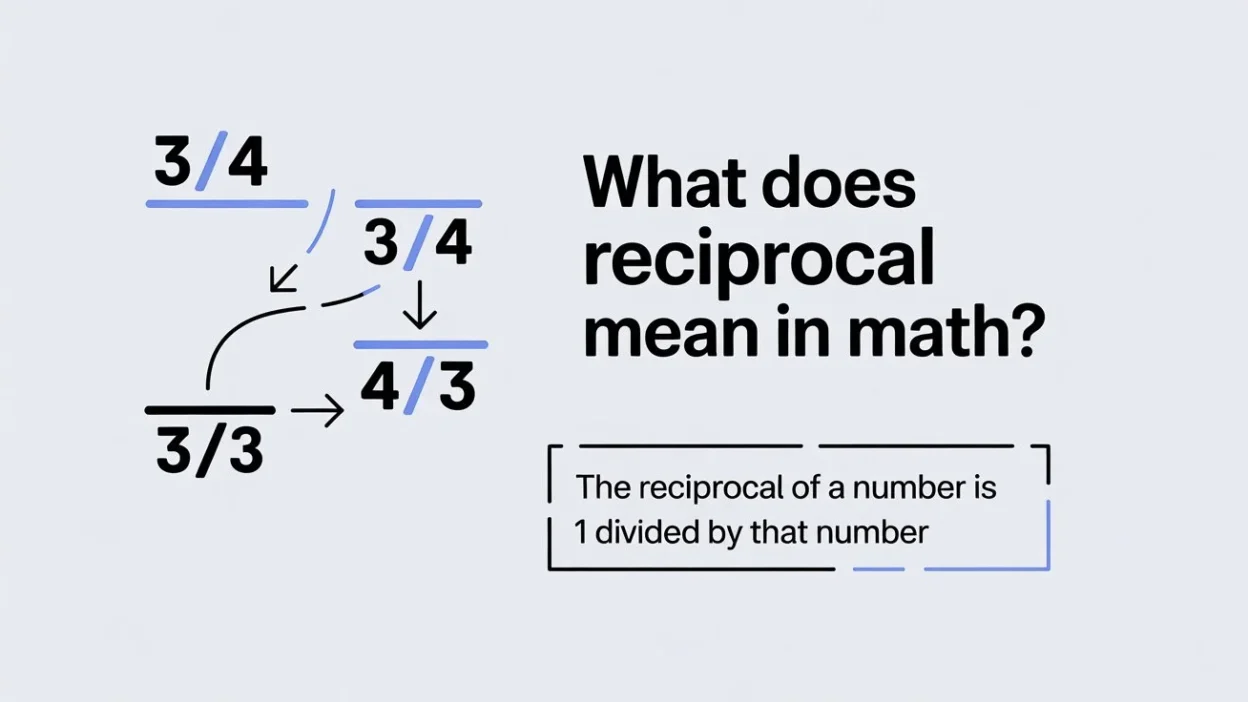
The reciprocal in math means flipping a number — turning it upside down so the numerator becomes the denominator and vice versa. It’s a simple math tool used for division, fractions, and solving equations.
What Does Reciprocal Mean in Math?
In math, the reciprocal of a number is what you get when you flip it.
If you have a fraction a/b, its reciprocal is b/a.
If the number is a whole number like 5, its reciprocal is 1/5 (because 5 = 5/1).
Real Example:
- Reciprocal of 3/4 → 4/3
- Reciprocal of 2 → 1/2
- Reciprocal of 0.5 → 2
Important Rule:
A number and its reciprocal always multiply to 1.
In short:
Reciprocal = flipped number = the value that multiplies to 1.
Where Is the Word “Reciprocal” Commonly Used?
You’ll see the term reciprocal most often in:
- 📘 School math classes
- 🧮 Algebra homework
- ➗ Fraction and division problems
- 📏 Geometry and ratios
- 🎮 Math-related games and puzzles
- 📚 Competitive exam prep (SAT, GRE, etc.)
Since it’s a math term, it isn’t used in casual texting or social media chats.
It’s formal, educational, and strictly math-related, not slang.
Examples of “Reciprocal” in Conversation
Here are simple, everyday-style conversations where someone might use the word reciprocal (usually during homework help or study chats):
A: can u help me with this fraction?
B: sure, just take the reciprocal of 4/7 — flip it 👍
A: what’s the reciprocal of 9?
B: it’s 1/9 cuz u put 9 under 1
A: my teacher said multiply by the reciprocal… what does that mean??
B: means flip the second number before multiplying
A: why is the reciprocal of 1 still 1?
B: cuz 1/1 flipped is still 1 😭
A: how do u divide fractions again?
B: multiply by the reciprocal, always 🤓
These examples show how the word appears naturally in math discussions.
When to Use and When Not to Use “Reciprocal”
✅ When to Use
Use “reciprocal” when you are:
- Solving fractions
- Dividing numbers
- Working on algebra problems
- Explaining a math step clearly
- Helping someone with homework
- Showing how two numbers relate (multiplying to 1)
❌ When Not to Use
Avoid using “reciprocal” when:
- Talking casually in everyday conversation
- Writing formal emails unrelated to math
- Texting friends (it’s not slang)
- Talking about emotions, relationships, or normal life topics
- Giving instructions outside of math
Comparison Table
| Context | Example Phrase | Why It Works |
| Math Class | “Take the reciprocal and multiply.” | Clear and educational |
| Homework Help | “Flip the fraction — that’s the reciprocal.” | Simple explanation |
| Tutor Session | “Every number has a reciprocal except 0.” | Correct mathematical rule |
| Normal Chat | “Don’t use this term here.” | It’s not casual slang |
Similar Math Terms or Alternatives
Here are some related math words that students often confuse with “reciprocal”:
| Term | Meaning | When to Use |
| Inverse | Opposite operation (add/subtract/etc.) | When solving equations |
| Multiplicative Inverse | A number that multiplies to 1 (same as reciprocal) | Advanced math discussions |
| Division | Splitting into parts | Basic arithmetic |
| Flip the Fraction | Slang for “reciprocal” | Casual homework help |
| Opposite Number | Same number but negative sign | Pre-algebra or integers |
| Ratio Inversion | Reversing numbers in a ratio | Geometry and proportions |
FAQs
1. What is the reciprocal of 0?
There is no reciprocal of 0 because you can’t divide by zero.
2. What is the reciprocal of a whole number?
Write the number as a fraction over 1, then flip it.
Example: 8 → 1/8.
3. Do reciprocals always multiply to 1?
Yes! That’s the key rule:
Number × Reciprocal = 1.
4. What is the reciprocal of a mixed number?
Convert it to an improper fraction, then flip it.
5. Can negative numbers have reciprocals?
Yes — just flip the fraction and keep the negative sign.
Example: −3 → −1/3.
6. Is “reciprocal” a slang word?
No. It’s a math term, not a texting expression.
7. What is the reciprocal used for?
Dividing fractions, simplifying equations, ratios, and solving many algebra problems.
Conclusion:
Understanding the reciprocal in math makes solving fractions, equations, and division problems much easier. Once you remember that it simply means “flip the number,” everything becomes clearer.
If you’re helping a friend with homework or tackling algebra on your own, reciprocals are a simple but powerful tool. Master them once, and you’ll use them forever — they’re one of math’s most helpful shortcuts.